
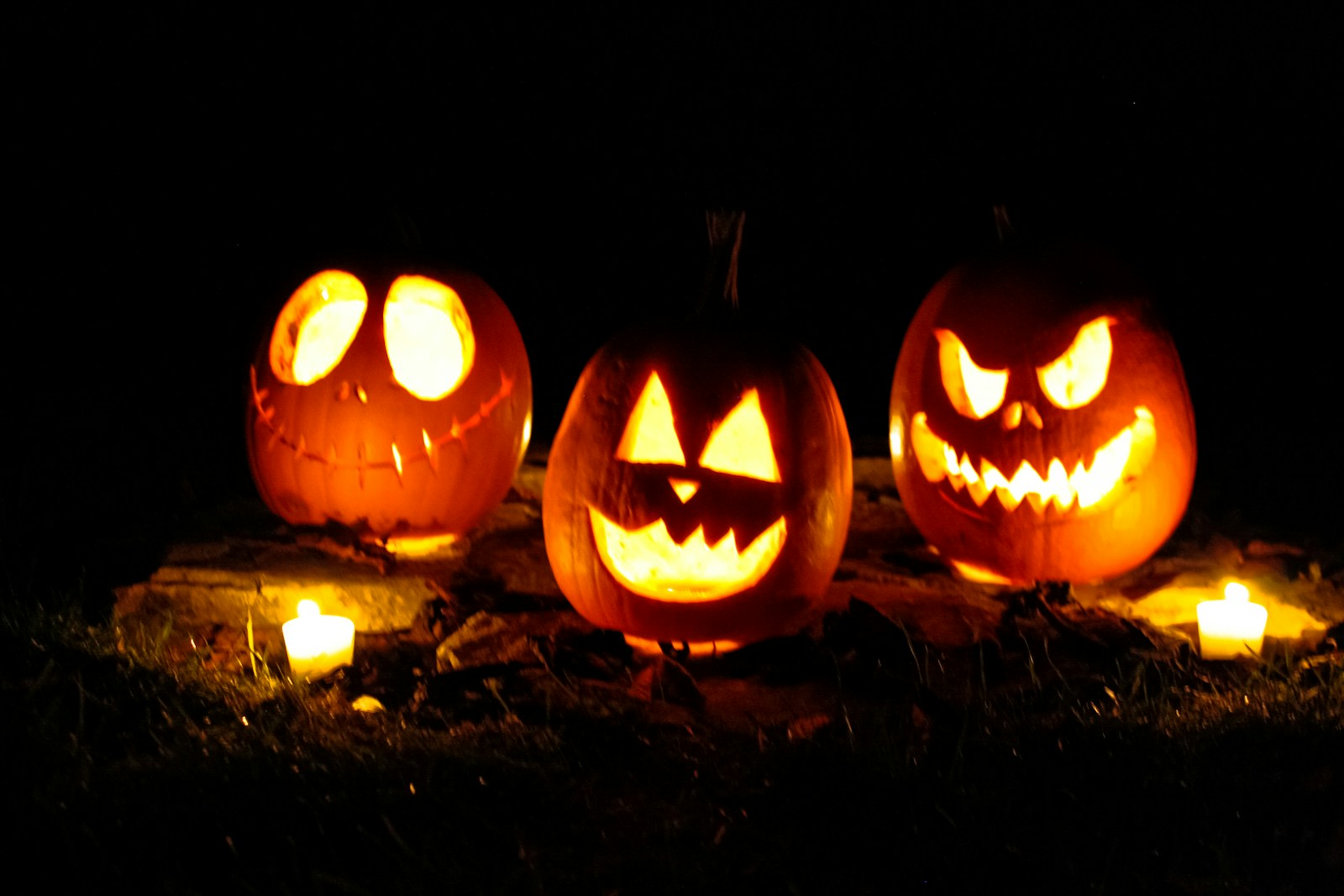
If you’ve ever tried to carve a pumpkin, you know it’s not as easy as it seems. The knife gets stuck, one eye ends up bigger than the other, and your jack-o’-lantern looks less “terrifying” and more “mildly concerned.” Necessity is the mother of invention, so it’s no surprise that in 1979, Christopher A. Nauman came up with a better way to carve a pumpkin, and then patented it. The Patent Office apparently enjoys a little drama, because U.S. Patent No. 4,296,659: Jack-O-Lantern Forming Method, was granted on October 27, 1981, four days before Halloween.
The idea is ghoulishly simple. You don’t have to hack away freehand. Instead, you set a die shaped like an eye, nose, or mouth against the pumpkin, give it a whack and drive it through the pumpkin wall. Pull out the plug, and presto: one facial feature. It’s basically a cookie cutter for pumpkins, with more percussion. Don’t worry, the patent is dead and buried (i.e., expired), so punch away.
The patent describes the die in loving detail, but Claim 1 doesn’t claim the die. It claims “a method of forming a jack-o’-lantern from a pumpkin.” The die may be the star of the specification, but the method is the hill this patent chose to die on.
I always tell inventors that you patent the how, not the what (of course, with a few exceptions). You can’t patent the idea of a scarier pumpkin, but you can patent how you get there. This patent took that advice more literally than most. It claims the how, one step at a time, mallet included.
When a patent attorney concocts a patent potion, there are a few ingredients on the shelf. In most cases, there’s the apparatus, which is the thing itself. There’s the system, which is several things working together, like a well-organized coven. And there’s the method, which is a series of steps for doing something. Think of it as the spell.
A method claim opens with a preamble that sets the scene like the first line of a ghost story: “A method of forming a jack-o’-lantern…” Then come the steps, usually written as “-ing” verbs. Here, the steps include providing the die, positioning it, striking it and driving it through the pumpkin wall.
The big rule is that every step counts. To infringe, someone generally has to perform every step. If you skip the striking, you might slip past the claim’s wording like a ghost through a wall. I’ll save you the gory details of the doctrine of equivalents, which simply states that you may still infringe if what you do is close enough to a claimed step, even if it does not literally match the claim’s wording.
Method claims also come in more flavors than a bag of fun-size candy. A method of making produces something, such as turning an innocent squash into a grinning lantern. A method of using covers a new use for something that already exists. A method of operating describes how a device works. That’s the pumpkin bread and butter of software patents. And a method of treatment covers giving a drug for a condition.
Trick or Treat?
The treat: A method claim can protect how something is done, even when the tool itself might not survive the prior art. And by 1979, the pumpkin patch was crowded. The patent cites an earlier jack-o’-lantern forming system, along with other cutting and punching references. No word on whether the examiner found any of it particularly gourd. Sorry. That one was unavoidable.
The trick: A method claim is infringed by whoever performs the steps. Here, that’s a family on their porch on October 30th, armed with a mallet and a dream. Suing your own customers is scary, and not the fun kind. To go after the company selling the dies, a patent owner would usually need an indirect theory. One example is induced infringement, such as instructions on the box that follow the claim a little too closely.
It gets worse. If Dad holds the die and the kid swings the mallet, nobody performed every step. That’s called divided infringement, and it generally requires that one person’s actions be legally attributable to the other, for example, because one directs or controls the other’s performance. Every parent already knows whether anyone truly controls an eight-year-old holding a mallet.
That’s why experienced drafters rarely rely on just one ingredient. Pair the method claim with an apparatus claim directed to the die, so it doesn’t go to its grave unclaimed, and another claim directed to a set or kit of dies, and you give the patent owner more than one path to enforcement.
The Serious Point Under the Mask
When an inventor says, “Here’s what we invented,” a patent prosecutor’s job is to look at it from every angle. Is the novelty in what was built, in how the parts work together or in what someone does with it? And who will actually be doing it? Those questions are easy with a pumpkin and a sharp object. They’re much harder with an AI architecture, a wireless protocol or a software platform, where method claims often do the heavy lifting, no mallet required.
How you frame an invention can matter as much as the invention itself. So remember: patent the how. Sometimes, as this pumpkin shows, you can do it quite literally.
So this Halloween, put a pumpkin in front of a few patent lawyers and ask what they’d claim.
The scary part isn’t the jack-o’-lantern.
It’s how many different answers you’ll get.