
The copyright community eagerly awaits an important decision from U.S. District Court for the District of Colorado. The case is Allen v. Perlmutter, and represents another test of the Copyright Office’s so-called “Human Authorship Rule.” Plaintiff Jason Allen, creator of the award-winning Théâtre D’opéra Spatial digital artwork, filed suit against the Copyright Office over the Office’s rejection of Allen’s application to register the copyright in his work. Last year, Allen moved for Summary Judgment[1] in the case, and in January of this year, the Office filed a Cross-Motion for Summary Judgment.[2] A decision on the motions is expected soon. The purpose of this post is to provide a refresher on the case, to review some of the key analogies and arguments employed by the parties, and to consider possible outcomes at the MSJ stage and implications.
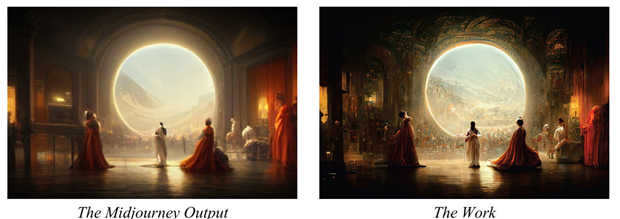
The facts of the case are widely known and not in dispute. Allen created his image with the assistance of Midjourney, a text-to-image generative AI tool. In the process, he famously used 624 separate prompts to achieve his desired outcome. The prompts apparently ranged from general prompts directing the overall subject of the piece to specific prompts specifying color, style, definition and other details. After that, Allen used other software tools to “upscale” the image and make further desired edits and revisions.
The Copyright Office Position
The parties’ summary judgment motions largely talk past one another. The Copyright Office essentially views the “work” as two works, one being the output generated by Midjourney, and the other being the derivative work resulting from the combination of the Midjourney output with Allen’s subsequent revisions and edits. The Midjourney output itself is categorically excluded from copyright under the Human Authorship Rule. This rule states that only expression by human authors is eligible for copyright. The Office has interpreted the rule to mean that outputs from prompts to generative AI tools are excluded from copyright, irrespective of number, types, specificity, etc. of the prompts used to produce the output. “[G]iven current generally available technology, prompts alone do not provide sufficient human control to make users of an AI system the authors of the output.”[3]
The Copyright Office concluded that the final version of the image was copyrightable, because it contained some authorship of Allen, separate from the Midjourney output. The Office was prepared to grant copyright registration to Allen on the final version, provided that Allen would disclaim any ownership of the underlying Midjourney output. This would have had the effect of relegating the vast majority of the “expression” in the piece to the public domain, because the post-AI adjustments were relatively minor (although not too de minimus for protection).[4]
Allen’s Position
Allen, in contrast, asserts that the work is a single work, produced by him using various assistive tools including Midjourney. Allen questions the premise of the Office’s conclusion, namely, that the Midjourney output portion of the work is automatically unprotectable. More specifically, Allen rejects the notion that the Human Authorship Rule requires exclusion of the Midjourney portion of the work. Rather, he asserts that there is in fact a human author, and that he is that author, and the work as a whole should be eligible for copyright registration with Allen listed as sole author and owner. Allen challenges the interpretation that “prompts alone are not enough” for authorship.[5] And that’s the essence of the matter: is there any point at which a user, through his or her prompts, has controlled the gen AI output sufficiently to claim authorship, or are prompts alone categorically insufficient to yield human authorship in a gen AI output?[6]
Dueling Analogies
One reason the parties’ summary judgment motions seem to talk past each other is that they rely on different analogies. The Copyright Office’s examples generally depict AI systems as autonomous generators of expression. In its view, a prompt such as “dog riding a bicycle” functions much like a commission or request. The user supplies a general concept, but the system independently determines the expressive details that actually appear in the resulting image. If that framing is correct, then the user’s contribution is arguably an uncopyrightable idea rather than protectable expression. The resulting image is principally authored by the system rather than the person who provided the prompt.
Allen’s framing proceeds from a different analogy. Copyright authorship is not necessarily conditioned on an author personally performing every physical or technical act by which a work becomes fixed. Rather, authors routinely rely on tools and intermediaries. A photographer relies on a camera. A novelist may dictate words to an assistant. A composer may employ a copyist. A film director depends on camera operators, editors, lighting technicians and other collaborators. In each of these cases, there are one or more “intermediaries” assisting the author to translate the author’s conception into a fixed work, but the intermediary’s participation does not necessarily displace the originating author as author. An “amanuensis” is the clearest example: the scribe supplies the hands, while the person dictating supplies the expression. The law has often looked beyond many of the actual acts involved in artistic expression to identify the individual responsible for the relevant creative decisions reflected in the final work.
Neither analogy appears completely satisfactory. The Copyright Office’s examples demonstrate that some prompts leave enormous expressive discretion to the AI system. But the traditional authorship analogies suggest that the mere presence of an intermediary does not itself necessarily sever authorship. The difficult question is whether generative AI always behaves like an independent creator supplying expression of its own, or whether, in some circumstances, it functions more like an instrument through which human expression is realized.
The Spectrum of Mediated Authorship
It seems intuitive that a prompt like “dog riding a bicycle” would be too general to yield copyright authorship for the human using a gen AI tool. The Copyright Office makes this point in its motion in the Allen case, pointing out that the prompt “white bunny with low ears, rainbow background, love, cute, happy” yielded various different options:
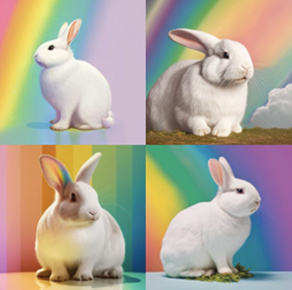
But does this type of example prove that all Midjourney outputs are categorically ineligible for copyright – that “prompts alone” are always insufficient?
Consider this image created using Microsoft Co-Pilot:

While not the Mona Lisa, this image probably has sufficient originality and creativity to meet the low threshold to qualify for copyright protection.
Here are the prompts used to create this image:
Prompt 1: Please create an image with three equally spaced concentric circles, with an equilateral triangle within the innermost circle, and touching the edges of the circle at its corners, and with a five-pointed star inside the triangle.
Response:

2. Can you please add color to the design? I’d like to add a blue background, pantone dark blue c, and have the inner area within the smallest circle and behind the triangle that same blue, pantone dark blue c, and the field of the triangle behind the star orange, pantone orange 21 c, and the star colored light blue, pantone 290 c.
Response:

3. No, the two outer circles should still be white. It’s only the exterior field, and the field of the inner circle (behind the triangle), that should be in the dark blue color.
Response:

Intuition suggests that the human author here should be entitled to claim ownership of this image and that it should be eligible for copyright protection. Was the use of a generative AI tool, with only the above “prompts alone,” categorically insufficient to entitle a claim of human authorship of the above image?
Counterarguments could of course be made to the example. One might suggest that the image was created using generative AI in a “non-generative,” “non-AI” way – something more like PowerPoint or Microsoft Paint. The tool was instructed using prompts containing highly detailed instructions describing geometric shapes and specific color tones that gave the tool very limited discretion. Thus, it does not seem to be the same kind of use as Allen’s use.
This example, however, exposes a broader point. Copyright authorship doesn’t necessarily depend on the author personally performing every physical or technical act by which a work comes into existence. Instead, there seems to be a spectrum of mediated authorship. At one end is the true amanuensis, whose role is confined to recording or mechanically implementing expression determined by another. At the other end is an independent creator who receives only a general idea or objective and supplies the particular expression embodied in the finished work. Between these poles are tools, methods, and human assistants that implement expression with varying degrees of discretion in realizing the initiating person’s creative vision.
| Situation | Role of intermediary | Source of expressive choices | Likely authorship result |
| Author dictates exact prose to assistant | Transcribes specified words | The dictating human determines the expression | Human remains the author[7] |
| Composer supplies a completed score to a copyist | Prepares a clean notation of the score | The composer determines the expressive musical content | Composer remains the author |
| Photographer arranges a scene and uses a camera | Fixes the selected composition | The photographer controls selection, arrangement, timing and framing | Photographer is the author[8] |
| Director plans shots executed by camera operators | Implements detailed creative direction | Authorship depends on the director’s control and the operators’ discretion | Potentially human authorship; fact-specific[9] |
| User specifies geometry, placement, and colors to software | Renders tightly constrained instructions | The user may determine nearly all protectable choices | Strong amanuensis-like case |
| User repeatedly prompts, selects, edits, and inpaints an AI image | Generates and revises expression interactively | Creative control is divided and may change over the process | Fact-intensive intermediate case |
| User asks AI to create “a beautiful fantasy landscape” | Supplies composition, forms, lighting, and details | The user supplies a concept but few particular expressive choices | Weak claim to authorship of the output |
The categories are not rigid, and the relevant inquiry should not turn on labels such as “tool” or “AI.” The better question is functional: which protectable expressive choices embodied in the final work can fairly be attributed to the person claiming authorship, and which were supplied independently by the intermediary? The chain of expression remains intact when the intermediary operates primarily as a conduit for the human’s expressive choices; it weakens, and may ultimately break, as the intermediary supplies more of the work’s particular expression.
As the above example suggests, generative AI can plausibly occupy different positions on this spectrum. As noted, a general request such as “dog riding a bicycle” leaves the system to determine nearly every protectable detail. In contrast, the above geometric-emblem instructions prescribed that work’s shapes, their relationship and placement, and the relevant colors, leaving the system comparatively little expressive latitude. Allen’s 624-prompt process presents an intermediate case: the legal significance should depend not merely on the fact that he used prompts to an AI system, but on what those prompts, together with his selection and revision decisions, actually controlled in the resulting work.
This does not mean that prompts to a gen AI system will commonly establish authorship, much less that every prompted output should be copyrightable. It suggests only that “prompts alone” can in fact be sufficient for human authorship. And, if a prompt or sequence of prompts can, in at least some circumstances, specify enough of a work’s protectable expression that the AI functions as an amanuensis-like instrument, then a categorical rule appears overinclusive. At a minimum, a determination should be made as to where the particular work falls on the spectrum of mediated authorship: whether the system merely implemented human-determined expression, whether it supplied the material expressive choices itself, or whether the resulting work contains some protectable human-authored elements and other elements that must be disclaimed.
In the Allen case, we are unable to tell where the work falls, because Allen did not disclose the 624 prompts to the Copyright Office when it requested that he do so. In theory, if in his 624 prompts Allen dictated the value of every pixel in the Midjourney output, then in that case Midjourney might be said to be a technical amanuensis or scribe, with Allen viewed as the author. On the other hand, if Allen’s prompts were more in the nature of “futuristic opera set with a portal to an alternate reality,” then Allen perhaps cannot be said to be the author of the Midjourney output. The answer, most likely, is somewhere between these two extremes.
Beyond Pixels: Copyright and Abstracted Levels of Expression
There is another issue presented by the Allen case that has received relatively little attention. Both Allen and the Copyright Office tend to frame the dispute in terms of control over the final visual output. This framing risks assuming that copyright protection rises or falls based upon who determines the location and value of the particular pixels appearing in the completed image.
Copyright doctrine, however, has not traditionally confined authorship merely to the surface of a work. The law recognizes that creative expression may exist at multiple levels of abstraction. This concept in American copyright jurisprudence normally traces back to Judge Hand’s famous “series of abstractions” discussion in Nichols v. Universal Pictures Corp.[10] The concept recognizes that a copyright-protected work can be understood at successive levels of generality, ranging from its most concrete details to increasingly abstract structures and relationships. Later decisions applying abstraction and filtration analysis similarly recognize that expression may reside in layers above the particular words, images, software code, and other literal manifestations.
This concept appears in other copyright traditions as well. As described by Professor P. Bernt Hugenholtz, German copyright law recognizes äußere Form (external form) and innere Form (internal form).[11] While this terminology has no direct American equivalent, the distinction captures a common idea, namely, that a work consists not only of its surface manifestation, but also of the creative structure, thematic content, organization, conceptual relationships and so forth embodied within that manifestation.
This is an important point for the Allen case and all cases in which gen AI outputs are automatically found ineligible for copyright and relegated to the public domain. The binary “prompts alone” interpretation risks collapsing the authorship inquiry into a question of pixel-level control.
More specifically, the approach may overlook the possibility that a human author contributed protectable expression at a higher level of abstraction. An artist may conceive a particular set of themes, symbols, relationships, narrative elements, plot, moods, visual hierarchies or conceptual structures, and communicate those expressive choices through a detailed set of prompts. A generative AI system may then determine the exact pixel configuration through which those choices are rendered. In that circumstance, the AI system’s role in generating the final manifestation does not necessarily resolve whether some of the underlying expressive conception originated with the human user.
To be clear, this observation does not establish authorship in any particular case. Copyright protects expression, not ideas, and many prompts clearly do little more than describe unprotectable ideas. Nor does the existence of abstract expressive features answer the difficult question of how much specificity or control is required to yield copyrightable expression rather than an uncopyrightable idea. Those questions would of course remain central to the analysis.[12]
What this observation does suggest, however, is that a binary distinction between “prompted output” and “human-authored expression” may be insufficient. If copyright law has historically recognized protectable expression residing in abstract layers beyond the surface level — themes, structure, architecture, arrangement, symbolism, plot, characters, allegory, tone, pattern, balance, composition, and so forth — then a rule focused exclusively on what entity determined the final arrangement of pixels may ultimately disallow some forms of human authorship that are legitimate and worthy of protection even though mediated through a gen AI tool in the final output. That is, if those elements would ordinarily constitute protectable expression when embodied through a painter, photographer, illustrator, novel, software program, or other traditional medium, it is not immediately obvious why they should lose copyright significance because the surface level expression was generated through an AI system.
Four Possible Outcomes in Allen at the MSJ Stage
With the above considerations in mind, it will be interesting to see how the Allen court rules on the parties’ pending motions. Here are some possibilities:
1. The Copyright Office Prevails
The simplest outcome would be a ruling largely adopting the Copyright Office’s position. Under this approach, the court would conclude that prompts alone are categorically insufficient to establish authorship in AI-generated outputs. Any protectable authorship would have to arise from post-generation editing, selection, arrangement, or other human contributions independent of the AI generated content itself.
Such a ruling would provide a clear and administrable standard. It would also validate the Office’s existing guidance. At the same time, critics might argue that the rule is overly rigid because it focuses on the presence of prompts in a gen AI context rather than the actual degree of control exercised through those prompts. It would be a relatively uncontroversial finding, but one that risks oversimplifying existing doctrine and ignoring the practical reality that generative AI is rapidly becoming woven into many creative workflows.
2. Allen Prevails
A second, less-likely possibility is that the court concludes that the Copyright Office has interpreted the human authorship requirement too narrowly. Under this approach, the court might hold that prompts, in at least some circumstances, and in particular in the present case, can establish sufficient human control to support authorship.
Such a decision would not necessarily mean that every AI-generated image is copyrightable. Rather, it would likely require a more nuanced inquiry into the relationship between the user’s creative decisions and the resulting output. This would represent a significant departure from the Office’s current approach and would likely have far-reaching implications for registration practice.
3. Both Motions Are Denied
Perhaps the most intriguing possibility is that neither party prevails in its current motion.
A denial of both summary judgment motions could signal that the court is unwilling to embrace either side’s categorical rule. The court might conclude that the Copyright Office has not established that prompts are always insufficient as a matter of law, while simultaneously determining that Allen has not demonstrated authorship strongly enough to prevail on the existing record.
In practical terms, such an outcome would suggest that the level of human control matters and that the inquiry cannot always be resolved through a binary assessment. It would leave open both Allen’s camera analogy and the Office’s contention that prompts alone are insufficient. This would be the outcome most consistent with viewing AI-assisted creation as a spectrum of mediated authorship rather than a black-and-white distinction between human and AI creation.
4. The Court Avoids the Core Question
Finally, the court may decide the case on narrower procedural or administrative-law grounds without squarely addressing the broader authorship question.
Courts sometimes avoid resolving difficult doctrinal issues when a case can be decided on more limited grounds. Such a ruling would provide little guidance regarding AI authorship, and it would postpone rather than resolve the underlying debate. The fundamental question would remain for future cases: at what point, if ever, does a human creator using prompts exercise sufficient control over an AI-generated work to qualify as its author?
Conclusion
Whatever happens, Allen v. Perlmutter is likely to become an important decision in the ongoing effort to reconcile traditional copyright principles with generative AI. The case ultimately asks a deceptively simple question: when a work emerges through a process involving both human direction and AI generation, how much of the resulting expression must be attributable to the human creator before copyright law recognizes authorship? The Copyright Office offers a categorical answer for the present state of technology. Allen proposes a more flexible one. The court’s decision may not only determine the registrability of Théâtre D’opéra Spatial, but also suggest the conceptual frameworks through which courts evaluate future AI-assisted creative works.
[1] Petitioner’s Motion for Summary Judgment and Memorandum in Support Thereof, Allen v. Perlmutter, No. 1:24-cv-02665-WJM (D. Colo. Aug. 7, 2025), ECF No. 46.
[2] Defendants’ Response to Plaintiff’s Motion for Summary Judgment and Memorandum in Support Thereof and Cross-Motion for Summary Judgment, Allen v. Perlmutter, No. 1:24-cv-02665-WJM (D. Colo. Feb. 6, 2026), ECF No. 58-1.
[3] U.S. Copyright Office, Copyright and Artificial Intelligence – Part 2: Copyrightability 18 (Jan. 2025).
[4] The Office’s argument in its Motion can be summarized as follows: (1) human authorship remains indispensable and, even though AI can assist in the creation of a copyrightable work, the copyright extends only to the human-authored portion; (2) prompts communicate instructions or ideas only and do not sufficiently control or determine the resulting expression; (3) iteration, selection and effort by Allen do not cure the lack of human authorship in the Midjourney output; (4) the camera analogy fails because the nature of Midjourney causes it to contribute far more expressive content of its own making; and (5) Allen could have registered the work had he agreed to the disclaimer of the Midjourney portion. Copyright Office MSJ at 9-41.
[5] Allen’s argument in his Motion can be summarized as follows: (1) Allen is the human author under ordinary copyright doctrine, in that copyright only requires minimal human creativity, and his contribution exceeds that low threshold; (2) using an automated technical intermediary does not defeat authorship; (3) Allen’s prompts were part of a substantial creative process demonstrating sufficient human control and creative judgment; (4) the Office applied an improperly restrictive conception of authorship; and (5) even under the Office’s own conception of authorship, Allen met the standard. Allen MSJ at 17-41.
[6] Allen’s position also attracted scholarly support from Professor Edward Lee, who argued the following in an amicus brief: (1) the Office’s focus on “traditional elements of authorship” in its “prompts-alone” interpretation is misplaced, and not supported by the Framers’ intent, the Copyright Clause or judicial precedent; (2) copyright’s broad conceptions of “authorship” and “writings” have in the past been, and are intended to be, forward-looking and accommodating of new technologies and methods of creation; (3) outputs from prompting cannot be categorically relegated to the realm of the unprotectable, but instead must be evaluated in each case based on the degree of creative control, selection, arrangement and so forth displayed; and (4) from a policy standpoint, the Office’s position, instead of promoting progress, impedes progress, in violation of the mandate of the Copyright Clause. Brief of Amicus Curiae Professor Edward Lee in Support of Plaintiff’s Motion for Summary Judgment at 2-15, Allen v. Perlmutter, No. 1:24-cv-02665-WJM (D. Colo. Sept. 3, 2025), ECF No. 47.
[7] Andrien v. S. Ocean Cnty. Chamber of Commerce, 927 F.2d 132, 135 (3d Cir. 1991).
[8] Burrow-Giles Lithographic Co. v. Sarony, 111 U.S. 53, 60–61 (1884).
[9] Lindsay v. The Wrecked & Abandoned Vessel R.M.S. Titanic, 52 U.S.P.Q.2d 1609, 1613–14 (S.D.N.Y. 1999); Aalmuhammed v. Lee, 202 F.3d 1227, 1233–35 (9th Cir. 2000).
[10] Nichols v. Universal Pictures Corp., 45 F.2d 119, 121 (2d Cir. 1930).
[11] P. Bernt Hugenholtz, Copyright and the Expression Engine: Idea and Expression in AI-Assisted Creations, 100 Chi.-Kent L. Rev. 251, 260 (2025).
[12] Professor Lee discusses some of the analytical challenges in assessing non-literal, abstracted expression in the context of AI outputs in Edward Lee, Vibe Coding Authorship, UCLA L. Rev. Discourse 10-14 (forthcoming 2026) (Mar. 28, 2026 draft).